The Moore Memorandum — Briefing 004
A briefing on how procurement systems shape innovation through specification, comparability, risk transfer, and institutional defensibility.
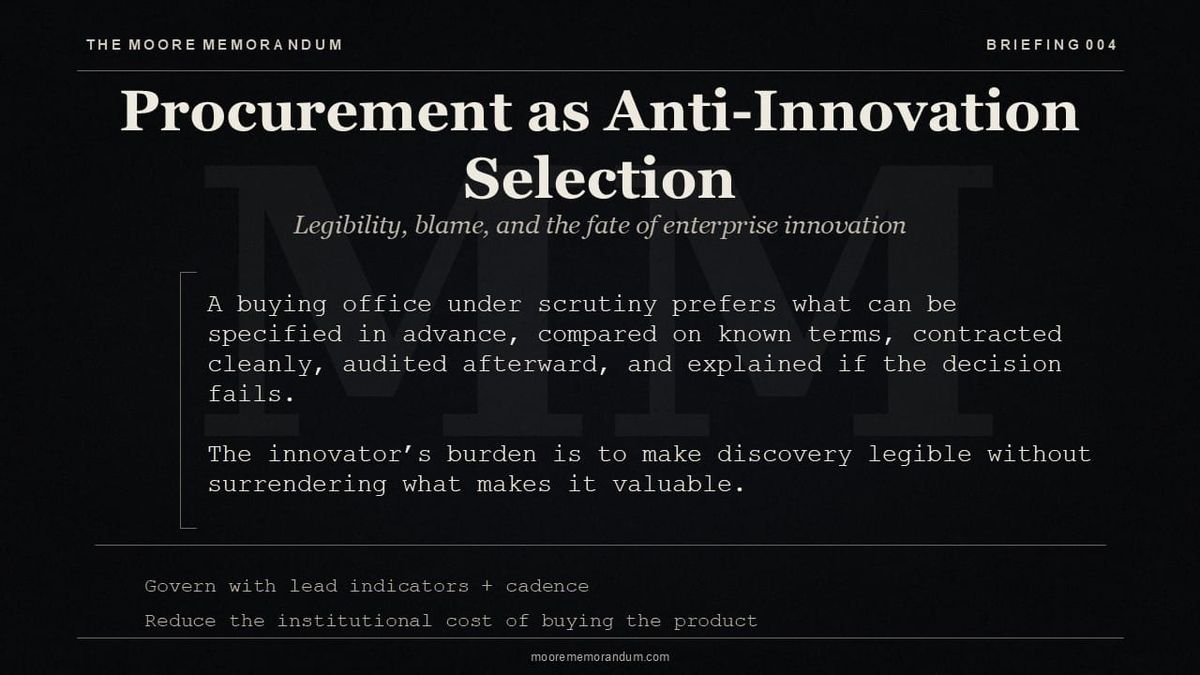
Procurement as Anti-Innovation Selection
Executive Summary
Procurement is often described as if it were a neutral buying function. It is not. It is a selection mechanism. And many procurement systems, by design, select against innovation.
This does not mean procurement officers are unintelligent, hostile, or timid. It means the system typically rewards properties that are easier to compare, defend, audit, and transfer risk against: specification-compliance, incumbent credibility, short-run price visibility, and procedural fairness. Those same properties are frequently absent from genuinely novel offers, especially early in their life. Research on public procurement repeatedly finds that over-specified tenders, weak buyer–supplier interaction, poor risk management, and low procurement capability hinder innovation; smaller and more R&D-intensive suppliers are especially disadvantaged. Procurement offices also shape how innovations are valued, rather than merely processing other people’s preferences. Meanwhile, procurement theory shows that competitive bidding and fixed-price structures work poorly when projects are complex, incompletely specifiable, and adaptive—exactly the conditions under which many innovations arrive.
The strategic conclusion is simple: if your innovation cannot survive the procurement logic of the buyer, it is not yet commercially real.
1) The Pattern
Most organizations tell themselves a flattering story about procurement. The story says that procurement exists to secure the best solution at the best cost while ensuring prudent stewardship.
That is partly true. But in practice, procurement often does something more specific and more limiting: it prefers what is legible before it prefers what is superior after implementation.
That preference creates a recurring asymmetry.
- The incumbent can point to references, certifications, known failure rates, standard contract terms, and a thick history of “already approved” uses.
- The innovator can point to potential.
Procurement, especially when under institutional scrutiny, routinely converts that asymmetry into a decision rule.
This is not irrational. It is a response to incentives. The procurement function is usually judged less harshly for buying the familiar and missing upside than for buying the novel and causing visible failure. In that sense, procurement is not anti-innovation because it dislikes novelty. It is anti-innovation because it is optimized to avoid certain kinds of blame.
2) Why Procurement Selects Against Innovation
There are four recurring mechanisms.
A) It prefers specification over discovery
Innovation is often valuable precisely because the final solution cannot be completely specified ex ante. The buyer needs interaction, iteration, adaptation, and supplier knowledge.
But procurement systems are frequently built to do the opposite: define the requirement in advance, standardize bids, compare apples to apples, and enforce formal fairness.
The result is visible in the innovation procurement literature. Suppliers consistently report that innovation is hindered by over-specified tenders, limited interaction with buyers, weak procurement capabilities, and poor risk management. Those barriers bite hardest for smaller and R&D-intensive firms—the very firms from which novelty often comes.
B) It rewards comparability, not optionality
A novel offer is hard to compare. It changes the basis of comparison.
Once the evaluation frame becomes “same spreadsheet, same line items, same service levels, same precedent set,” the incumbent gains an invisible advantage: not necessarily because it is better, but because it is easier to score.
This is one reason public procurement can be a powerful innovation instrument when designed well, but a suppressor of innovation when designed poorly. The difference lies in whether the system is willing to buy outcomes, experimentation, and learning—or only fully specified deliverables.
C) It transfers risk onto the seller in ways innovation cannot always bear
Procurement frequently encodes a legitimate desire: push uncertainty, performance risk, and adaptation risk onto the supplier.
The problem is that innovation often arrives in settings where uncertainty cannot be priced cleanly. Procurement economics has long shown that when projects are complex and specifications are incomplete, rigid fixed-price structures and auction-like selection can perform poorly. Cost-plus or negotiated forms become preferable not because incentives do not matter, but because adaptation and renegotiation costs matter more than the clean fiction of ex ante completeness.
This is a profound point for executives: if you insist on a procurement regime designed for stable, fully specifiable work, you will systematically repel the solutions whose value depends on adaptation.
D) It is an institution of valuation, not a clerical conduit
One of the most important recent findings in this area is that procurement offices do not merely transmit the preferences of “the real decision-makers.” They actively shape how innovations are valued, framed, and rendered comparable. In healthcare procurement, for instance, procurement offices function as professional intermediaries that influence markets and the valuation of goods, rather than serving as passive administrative pass-throughs.
That matters beyond public procurement. It means the procurement function is not a neutral hallway the innovation must pass through. It is one of the rooms in which the innovation is judged and translated into institutional language.
3) The Real Strategic Error
The standard founder error is to think:
“If the value proposition is strong enough, procurement will eventually see it.”
That is usually false.
Procurement does not evaluate only value. It evaluates:
- specification completeness,
- implementation burden,
- referenceability,
- contractual risk,
- auditability,
- internal defendability
An innovation can dominate on user value and still lose on procurement legibility.
This is why many ventures misread rejection. They believe the buyer “didn’t understand the product.” Often the buyer understood the product well enough. What they could not accept was the change in procurement burden, governance burden, or blame surface.
4) The Correct Test
A serious innovator should not ask only:
“Is the product better?”
They should ask:
“What kind of procurement system would have to exist for this to be buyable?”
That is a more honest question, because it forces the venture to confront not just customer need, but buyer machinery.
You should assume procurement will ask, implicitly or explicitly:
- Can I specify this without depending on your continuing ingenuity?
- Can I compare you against known alternatives?
- Can I defend the decision internally if this fails?
- Can I contract around your uncertainty?
- Can I source this repeatedly, not heroically?
If the answer is “not yet,” that may still be fine. But then the problem is not sales. It is procurement readiness.
5) What Serious Firms Do About It
The answer is not to rail against procurement. The answer is to design for it without becoming captive to it.
A useful discipline is to separate three layers:
Layer 1: The innovation itself
What is truly novel, and what is not?
Layer 2: The procurement surface
Which aspects can be made legible—reference cases, security/compliance artifacts, service commitments, staged deployment, outcome specifications, bounded guarantees?
Layer 3: The buying path
Who signs, who scores, who bears implementation risk, who gets blamed, and what evidence changes their position?
This is where many strong companies win. They do not merely improve the product; they reduce the institutional cost of buying the product.
6) A Better Way to Think About “Procurement Fit”
Procurement fit is not the same as product–market fit.
A product can fit a market and still fail procurement.
A product can fit procurement and still fail users.
The companies that compound manage both.
So the right executive question is not:
“Why is procurement slowing us down?”
It is:
“What exactly is procurement selecting for here, and do we want to win on those terms, redesign the offer, or route around the function entirely?”
That is a strategy question, not an administrative one.
Closing
Procurement is one of the least romantic and most consequential institutions in enterprise life. It determines which innovations become products, which products become standards, and which standards become the market.
If your innovation is repeatedly losing in procurement, the most naive response is to complain that the buyer is timid. The more serious response is to ask whether the procurement system is selecting against novelty by construction—and, if so, whether you are prepared to alter the product surface, the contracting model, or the target market until that selection pressure works for you instead of against you.
Procurement is not anti-innovation because it is cynical.
It is anti-innovation whenever it is optimized for comparability, blame-avoidance, and static specification under conditions that require learning.
It is a fact that must be considered in the design.
Sources
- Jakob Edler and Luke Georghiou, “Public procurement and innovation—Resurrecting the demand side,” Research Policy 36, no. 7 (2007): 949–963. The paper argues that procurement can be a powerful demand-side innovation policy instrument but also emphasizes its pitfalls and institutional design challenges.
- Elvira Uyarra, Jakob Edler, José García-Estevez, Luke Georghiou, and Jillian Yeow, “Barriers to innovation through public procurement: A supplier perspective,” Technovation 34, no. 10 (2014): 631–645. Suppliers identified over-specified tenders, limited buyer–supplier interaction, weak procurer capabilities, and poor risk management as major barriers; small firms and R&D-intensive organizations were especially disadvantaged.
- Patrick Bajari and Steven Tadelis, “Incentives versus Transaction Costs: A Theory of Procurement Contracts,” RAND Journal of Economics 32, no. 3 (2001): 387–407. The core result is that more complex and incompletely specifiable projects favor more adaptive contractual forms, because ex post adaptation and renegotiation costs can dominate the incentive virtues of rigid fixed-price designs.
- Patrick Bajari, Robert McMillan, and Steven Tadelis, “Auctions Versus Negotiations in Procurement: An Empirical Analysis,” Journal of Law, Economics, and Organization 25, no. 2 (2009): 372–399. They show that auctions perform poorly when projects are complex, design is incomplete, and communication with suppliers matters—precisely the conditions under which innovation often enters.
- Fiona A. Miller and Pascale Lehoux, “The innovation impacts of public procurement offices: The case of healthcare procurement,” Research Policy 49, no. 7 (2020): 104075. Their key contribution is to show that procurement offices are not passive conduits; they actively shape the valuation of goods and the markets through which innovation is exchanged.