The Moore Memorandum — Briefing #005
The boardroom sees outcomes; the floor contains the mechanism. This briefing explains how disciplined go-and-see practice helps leaders find the bottlenecks, workarounds, handoffs, and customer friction that dashboards average away.
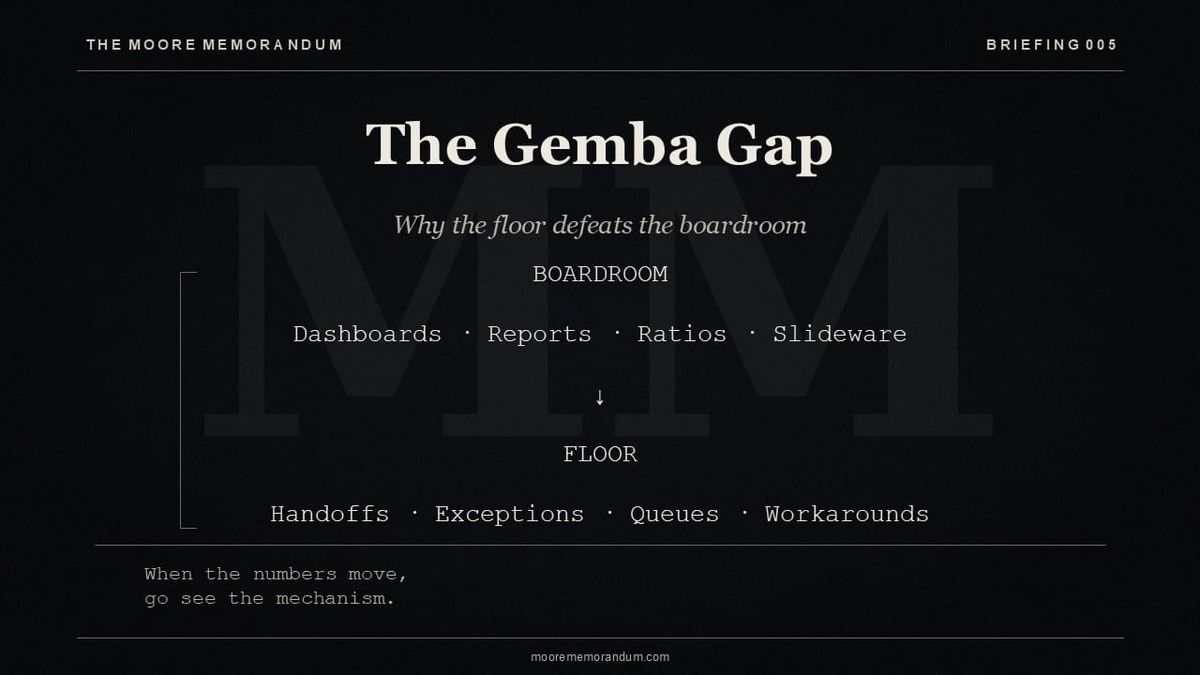
The Gemba Gap: Why the Floor Defeats the Boardroom
Executive Summary
- Executive rooms compress reality. They turn customers, operators, suppliers, defects, handoffs, exceptions, and delays into abstractions: revenue lines, margin movements, conversion rates, churn curves, dashboards, and slideware.
- The compression is useful for governance; it becomes dangerous when leaders mistake the abstraction for the mechanism.
- The gemba gap is the distance between how the operating system is imagined in leadership discussions and how value is actually created, delayed, distorted, or lost where the work occurs.
- A disciplined “go-and-see” protocol gives executives a way to inspect value creation directly without turning the visit into theater, blame, or anecdotal management.
- The practical objective is to convert direct observation into corrective action: identify the real bottleneck, the hidden workaround, the broken handoff, the unowned queue, or the customer friction that the dashboard is averaging away.
1. The Pattern
Every organization has a map. The map may be a budget, a CRM dashboard, a product roadmap, a process diagram, a pipeline report, or a board pack. The map is necessary. It allows leadership to coordinate across complexity.
The danger comes when the map becomes more trusted than the territory.
A leadership team sees:
- “conversion is down,”
- “cycle time is high,”
- “customer satisfaction declined,”
- “renewals are soft,”
- “support costs are rising,”
- “implementation is behind plan.”
Those statements describe outcomes. They rarely reveal the operating cause.
The cause is usually somewhere smaller, duller, and more concrete:
- a customer waits three days for an answer because no one owns the handoff;
- a sales promise collides with an onboarding workflow;
- a product feature works in demo and breaks in ordinary use;
- a procurement rule adds invisible delay;
- a support script solves the ticket and loses the customer;
- a dashboard shows “active users,” while the actual user is trapped in an exception path.
The floor defeats the boardroom because the floor contains the mechanism.
2. Why Abstraction Hides Failure Modes
Executive abstraction usually fails in four ways.
A. Averages conceal where the system breaks
A dashboard may report a median response time, average conversion rate, or blended retention number. The customer experiences a particular path, with particular delays and particular defects.
Averages can hide the segment, geography, process step, or handoff where value actually disappears.
B. Process maps omit exceptions
Most process maps describe the intended route. The enterprise fails in exception handling.
The valuable question is often:
What happens when the customer does something ordinary that the system did not expect?
That is where queues, escalation gaps, and ownership ambiguity appear.
C. Reporting layers sanitize pain
By the time a frontline defect reaches leadership, it has usually been summarized, reworded, normalized, or buried inside a category. The report may be accurate and still be unhelpful.
A report says: “implementation delays increased.”
The floor says: “the client cannot upload documents because the intake form rejects their file type, support knows the workaround, sales never learned it, and engineering does not see the tickets because they are categorized as onboarding.”
That second sentence can be managed.
D. Familiarity creates false understanding
Executives often believe they understand a process because they know its labels. Psychology has a name for this kind of overconfidence: the illusion of explanatory depth. People frequently overestimate their understanding of mechanisms until they are asked to explain the mechanism step by step. [5]
The cure is to observe the mechanism.
3. What “Gemba” Means for Executives
In lean practice, gemba means the actual place where value-creating work occurs. Lean Enterprise Institute describes it as the place where value is created and connects it to genchi gembutsu, commonly rendered as “go and see.” A gemba walk is a management practice for grasping the current situation through direct observation and inquiry before taking action. [2]
This doctrine is often trivialized into “management by walking around.” That misses the discipline.
A proper go-and-see practice has three commitments:
- Observe the real value stream. Follow the work end-to-end, across departments and handoffs.
- Ask mechanism questions. Identify what triggers action, what creates delay, what defines success, and what happens when the normal path breaks.
- Respect the operator’s knowledge. The person closest to the work often knows the workaround, the constraint, and the quiet failure before leadership does.
Spear and Bowen’s study of the Toyota Production System is useful because it describes Toyota’s operating discipline through rules around work specification, direct connections, simple pathways, and improvement through the scientific method at the lowest possible level in the organization. [1]
That is the executive lesson. The floor is not a site visit. It is the testing ground for the operating theory.
4. The Gemba Gap
The gemba gap is the distance between the executive theory of value creation and the observed mechanism of value creation.
It appears when leaders say:
- “customers are not adopting,” while customers cannot complete onboarding;
- “sales needs better messaging,” while the real issue is implementation credibility;
- “the product is not sticky,” while the customer never reaches time-to-value;
- “support is too expensive,” while sales sold unsupported configurations;
- “the team needs urgency,” while the bottleneck is an approval queue no operator controls.
The gap is usually visible to frontline actors long before it appears in financial results. It stays hidden because the organization lacks a disciplined path for moving observed reality upward without distortion.
5. The Go-and-See Protocol
The following protocol is designed for founders, executives, board members, and senior operators. It works for customer acquisition, product deployment, membership conversion, procurement, onboarding, service delivery, manufacturing, software incidents, and renewal operations.
Step 1 — Choose one value stream
Pick one path that matters this week.
Examples:
- lead to qualified opportunity;
- demo to signed customer;
- signed customer to activated user;
- purchase order to delivery;
- ticket opened to issue resolved;
- renewal risk flagged to renewal saved;
- feature released to user adoption.
Avoid touring the whole business. Follow one path.
Step 2 — State the executive theory
Before observing, write the leadership theory in one paragraph:
We believe this process creates value by doing X, through sequence Y, with bottleneck Z.
This matters because observation without a prior theory is merely sightseeing. Observation with a prior theory is how a test is even possible.
Step 3 — Follow one real case end-to-end
Select one real customer, order, ticket, member, user, or transaction. Follow it from start to finish.
Record:
- every handoff,
- every wait,
- every rework loop,
- every exception,
- every system involved,
- every unclear owner,
- every point where the customer loses momentum.
Do not ask first, “What is the policy?” Ask first, “What happened in this case?”
Step 4 — Separate value time from waiting time
For each step, record whether the step:
- creates value,
- protects quality/risk,
- transfers information,
- waits,
- reworks,
- duplicates,
- corrects,
- escalates.
Most processes contain much less value time than leadership assumes. The lesson is not “cut everything.” The lesson is to know which delays protect value and which delays merely accumulate.
Step 5 — Ask five mechanism questions
At each failure point, ask:
- What triggered this step?
- Who owns the next action?
- What information was missing?
- What rule or system created the delay?
- What workaround do experienced people use?
The workaround is especially important. A workaround is often the organization’s private admission that its formal process is broken.
Step 6 — Return with one correction
The visit should produce one specific correction.
Examples:
- rewrite the onboarding trigger;
- remove an approval step;
- change ownership of a handoff;
- redesign a support macro;
- change a qualification rule;
- fix one field in a form;
- create an escalation threshold;
- alter a sales promise;
- add a customer-facing explanation;
- kill a misleading metric.
Going to the floor should be a corrective discipline: it tests managerial assumptions against operating reality.
6. The Gemba Ledger
Use a simple ledger.
| Observation | Evidence | Consequence | Owner | Correction | Due date |
|---|---|---|---|---|---|
| Handoff from sales to onboarding lacks owner | 3 observed cases waited >48h | Customer momentum lost | COO | Assign owner at contract signature | Friday |
| Support macro solves ticket but frustrates customer | 5 tickets show repeated customer reply | Ticket closed, issue unresolved | Head of CS | Rewrite macro and add escalation rule | Tuesday |
| Product activation requires unsupported file type | User blocked during onboarding | Conversion delayed | Product lead | Add accepted file formats or validation message | Next sprint |
A ledger forces observation to become better management.
7. Bad Gemba and Good Gemba
Bad gemba
- leaders arrive unprepared;
- operators feel inspected rather than consulted;
- the visit turns into blame;
- executives chase anecdotes;
- findings never reach the operating cadence;
- visible problems become heroic one-off fixes;
- the same failure returns the next month.
Good gemba
- leadership arrives with a hypothesis;
- one real value stream is followed end-to-end;
- frontline knowledge is treated as evidence;
- the customer path is observed directly;
- failure points are converted into a ledger;
- one owner is assigned per correction;
- the next review checks whether the correction changed the leading indicator.
The difference is discipline.
8. Where This Matters Most
The gemba gap is most dangerous in five settings.
1. Customer acquisition
The model says “qualified lead.” The floor reveals whether the lead was ever qualified, whether follow-up occurred, whether the promise matched the product, and whether the customer trusted the next step.
2. Product onboarding
A customer signs. Value still has to be delivered. The floor reveals time-to-value, activation friction, setup delays, and silent churn before the renewal report does.
3. AI and automation
Automation often transfers work rather than eliminates it. The floor reveals whether the “automated” process creates new exceptions, audit burdens, mistrust, or manual repair.
4. Procurement and enterprise sales
The board sees pipeline. The floor sees security review, legal review, budget cycle, vendor registration, reference calls, political vetoes, and procurement language.
5. Governance under stress
When governance gets heated, abstraction increases. A disciplined evidence path matters more. The organization needs observed facts, clear ownership, and a single question under consideration.
9. Board and C-Suite Questions
Executives should ask:
- Which value stream have we personally observed this quarter?
- Which customer path do we think we understand but have not watched recently?
- Where does the dashboard show an outcome without explaining the mechanism?
- Which handoff has no named owner?
- Which frontline workaround has become unofficial policy?
- Where does the customer wait while we believe the process is moving?
- Which leading indicator would change first if our correction worked?
- What did we change after the last gemba review?
The final question is the most important. A gemba practice that produces no changed process becomes theater.
Closing
The boardroom is built for compression. The floor contains the mechanism.
A serious enterprise needs both: abstraction for governance, observation for truth. The gemba discipline gives leadership a way to reconnect those two levels before small operating failures become strategic conclusions.
The rule is simple:
When the numbers move, go see the mechanism.
Sources
[1] Steven J. Spear and H. Kent Bowen, “Decoding the DNA of the Toyota Production System,” Harvard Business Review, September–October 1999.
[2] Lean Enterprise Institute, “Gemba,” Lean Lexicon.
[3] Katherine N. Lemon and Peter C. Verhoef, “Understanding Customer Experience Throughout the Customer Journey,” Journal of Marketing 80, no. 6 (2016): 69–96.
[4] Christopher Meyer and Andre Schwager, “Understanding Customer Experience,” Harvard Business Review, February 2007.
[5] Leonid Rozenblit and Frank Keil, “The Misunderstood Limits of Folk Science: An Illusion of Explanatory Depth,” Cognitive Science 26, no. 5 (2002): 521–562.
[6] Peter M. Gollwitzer, “Implementation Intentions: Strong Effects of Simple Plans,” American Psychologist 54, no. 7 (1999): 493–503.