The Moore Memorandum — Briefing #006
“Scale Channel” Failure in DCF
Executive Summary
- A discounted cash flow model can look disciplined while hiding the most important question: by what channel does scale actually arrive?
- The “scale channel” is the concrete path by which growth is produced: customer acquisition route, distribution partner, procurement process, installed-base expansion, renewal motion, pricing ladder, implementation capacity, or market diffusion path.
- A DCF fails when revenue growth is entered as a scalar while the operating path required to generate that growth remains untested.
- The common failure modes are channel-capacity illusion, CAC reset, customer-mix degradation, conversion-rate optimism, implementation bottlenecks, and diffusion timing error.
- The remedy is a scale-channel audit: every revenue-growth assumption must be tied to a named channel, conversion chain, cost structure, capacity constraint, and leading indicator.
1. The Pattern
The DCF gives leadership a familiar comfort: future cash flows, discount rate, terminal value, sensitivity table, downside case.
The danger comes when the model treats scale as an accounting forecast rather than an operating achievement.
A spreadsheet may say:
Revenue grows from $5 million to $25 million in four years.
The operating system must answer:
Through which customers, through which channel, at what conversion rate, at what acquisition cost, with what implementation capacity, and with what retention quality?
Many DCF errors begin precisely here. The model contains a growth rate. The business lacks a scale channel.
2. What the Scale Channel Is
A scale channel is the route by which the enterprise converts market potential into realized, retained, profitable volume.
Examples:
- outbound enterprise sales;
- partner-led distribution;
- product-led growth;
- referrals;
- paid acquisition;
- procurement frameworks;
- marketplaces;
- community/membership growth;
- installed-base upsell;
- standards-driven adoption;
- geographic expansion;
- renewal and expansion motions.
A channel is more than a source of leads. It includes the entire path from awareness to qualified demand, from demand to signed contract, from contract to activation, from activation to retention, and from retention to profit.
That distinction matters because growth can fail at any stage. The DCF usually sees the final revenue line. The customer sees the journey. The operating team sees the handoffs.
Customer-journey research is useful here because it treats customer experience as movement across touchpoints rather than a single transaction; Lemon and Verhoef’s Journal of Marketing synthesis emphasizes customer journeys across multiple stages, touchpoints, and channels.
3. The DCF’s Hidden Assumption
A typical revenue forecast embeds an implied channel model, whether management writes it down or not.
If projected revenue is:
then the DCF is silently claiming that a channel exists that can generate that growth.
A more honest expression is:
where:
- N_t = active customers/users/members/accounts;
- ARPU_t = average revenue per active customer;
- Retention_t = persistence of customer value over the relevant period.
And N_t itself comes from a channel process:
where:
- H_t = channel or implementation capacity;
- B_t = acquisition budget;
- c_t = cost per top-of-funnel attempt;
- p_k,t = conversion probability at stage k.
This is the scale-channel test.
If the DCF assumes R_t but the channel cannot produce N_t, the valuation is not conservative or aggressive. It is mechanically detached.
4. Failure Mode 1: Channel-Capacity Illusion
A channel has finite throughput.
Enterprise sales teams can only run so many credible cycles. Implementation teams can only onboard so many customers. Distribution partners can only carry so many new products. Procurement systems can only approve so many vendors. Communities can only absorb so much promotional pressure before trust erodes.
A DCF often assumes growth can be purchased with additional spend. The scale channel may impose a harder ceiling.
This matters especially in complex sales and innovation markets. A firm may generate leads faster than it can qualify them, sign customers faster than it can onboard them, or deploy accounts faster than customers can absorb the operating change.
The board question:
What is the maximum number of high-quality customers this channel can convert and activate this quarter without degrading retention?
If management cannot answer, the DCF is using a growth number without a channel capacity.
5. Failure Mode 2: CAC Reset
Early customers often arrive cheaply.
They may be founders’ contacts, warm referrals, early adopters, mission-aligned buyers, or unusually tolerant partners. Later customers arrive through colder channels, heavier proof requirements, paid acquisition, procurement friction, or channel incentives.
The cost of acquisition resets upward as the firm moves beyond the first wedge.
Customer-equity research gives the correct discipline: acquisition should be evaluated through expected customer value, not simply volume. Rust, Lemon, and Zeithaml frame marketing strategy around customer equity; Reinartz, Thomas, and Kumar examine how firms should balance acquisition and retention resources to maximize customer profitability.
The practical test:
\[ CAC_t < CLV_t \]
If the model improves revenue while CAC_t rises and CLV_t falls, growth is eating the enterprise.
6. Failure Mode 3: Customer-Mix Degradation
The first customers may have strong willingness to pay, low support burden, and high retention. The next cohort may be more expensive to acquire, more demanding to serve, and less loyal.
The DCF hides this when it uses a single margin profile.
Scale often changes the customer mix:
- from enthusiasts to pragmatists;
- from founder-led sales to professional procurement;
- from simple deployments to complex integrations;
- from high-fit buyers to marginal buyers;
- from low-support customers to operationally expensive accounts.
A company can grow revenue and dilute enterprise quality.
The board question:
Does the next cohort have the same economics as the first cohort?
If the answer is unknown, the valuation should not inherit the early cohort’s margin and retention assumptions.
7. Failure Mode 4: Conversion-Rate Inheritance
A DCF often inherits conversion assumptions from a prior stage of the business.
That is dangerous.
A conversion rate observed in one channel rarely transfers cleanly to another. Referral conversion, founder-led conversion, paid conversion, enterprise procurement conversion, and channel-partner conversion belong to different operating systems.
The conversion chain should be written explicitly:
Each stage has a rate. Each rate has a capacity. Each rate has a failure mode.
A valuation that says “revenue grows 40%” without specifying which stage improves is relying on inherited optimism.
8. Failure Mode 5: Diffusion Timing Error
Some products scale through market diffusion rather than pure sales execution. The timing of adoption matters as much as the eventual market size.
Bass’s classic diffusion model shows that new-product adoption can be understood through innovation and imitation effects; the timing of initial purchase depends in part on prior adoption, and the model was developed and tested against consumer durables data.
The managerial implication is direct:
A market can be real and still arrive too late for the firm’s financing, staffing, or covenant calendar.
The DCF may be directionally right about eventual adoption and still wrong about enterprise survival.
This is especially important for:
- category-creating products;
- regulated innovations;
- infrastructure-dependent systems;
- platform markets;
- enterprise software requiring behavior change;
- products requiring standards or complementor participation.
The scale channel has a time constant. Discounted cash flow should respect it.
9. Failure Mode 6: Implementation Bottleneck
A customer counted in the forecast must become a working account.
The model may treat closing as the end of acquisition. The operating business knows closing is the start of delivery.
Implementation bottlenecks appear as:
- delayed onboarding;
- integration backlogs;
- training burden;
- support overload;
- customer data problems;
- internal change management;
- deployment customization;
- procurement-to-activation gaps.
A DCF that books revenue at contract signature while the organization earns value only after activation will overstate both timing and cash flow.
The relevant metric is time-to-value, not just time-to-close.
10. The Scale-Channel Audit
Before approving a growth forecast, leadership should force every material revenue assumption through the following audit.
| Question | Required Answer |
|---|---|
| What channel produces the growth? | Named channel, not “sales” or “marketing” generally. |
| What customer segment is being scaled? | Specific segment with evidence of demand and economics. |
| What is the conversion chain? | Stage-by-stage path with rates. |
| What is the channel capacity? | Maximum quality throughput before performance degrades. |
| What is the CAC trajectory? | Expected cost movement by cohort and channel. |
| What is the retention profile? | Cohort-level retention, not blended average. |
| What is the implementation burden? | Onboarding, support, integration, training, workflow change. |
| What is the time constant? | Adoption timing and ramp speed. |
| What leading indicator validates the assumption? | Observable metric before revenue appears. |
| What breaks first? | The likely bottleneck if growth underperforms. |
A growth forecast that cannot answer these questions belongs in an idea memo, not in a valuation.
11. The Board-Level Test
A board should ask six questions when reviewing a DCF for a growth company or innovation project:
- Which channel produces each layer of revenue growth?
- Does the channel have demonstrated capacity at the required scale?
- Are later customers expected to resemble early customers?
- Does CAC rise as the firm moves from warm to colder demand?
- Does activation capacity match closed-sales volume?
- Which leading indicator will tell us, within 30–60 days, whether the scale assumption is wrong?
The final question is the governance hinge. Revenue arrives too late to govern the channel. The leading indicator must move first.
12. Corrective Doctrine
When a scale-channel failure is discovered, management has four legitimate responses.
1. Narrow the forecast
Reduce growth to match demonstrated channel capacity.
2. Change the channel
Replace the path: partner-led instead of direct, product-led instead of outbound, installed-base expansion instead of new-logo acquisition.
3. Redesign the product surface
Lower implementation burden, simplify onboarding, compress time-to-value, or alter packaging.
4. Reprice or resequence
Increase margin, reduce payback period, target higher-quality customers first, or delay scale until the channel matures.
The wrong response is exhortation. “Sell harder” is not a channel strategy.
Closing
The DCF is a useful instrument when its growth assumptions are tied to an operating path. It becomes dangerous when revenue growth is entered as a smooth future line while the business lacks a feasible route to produce it.
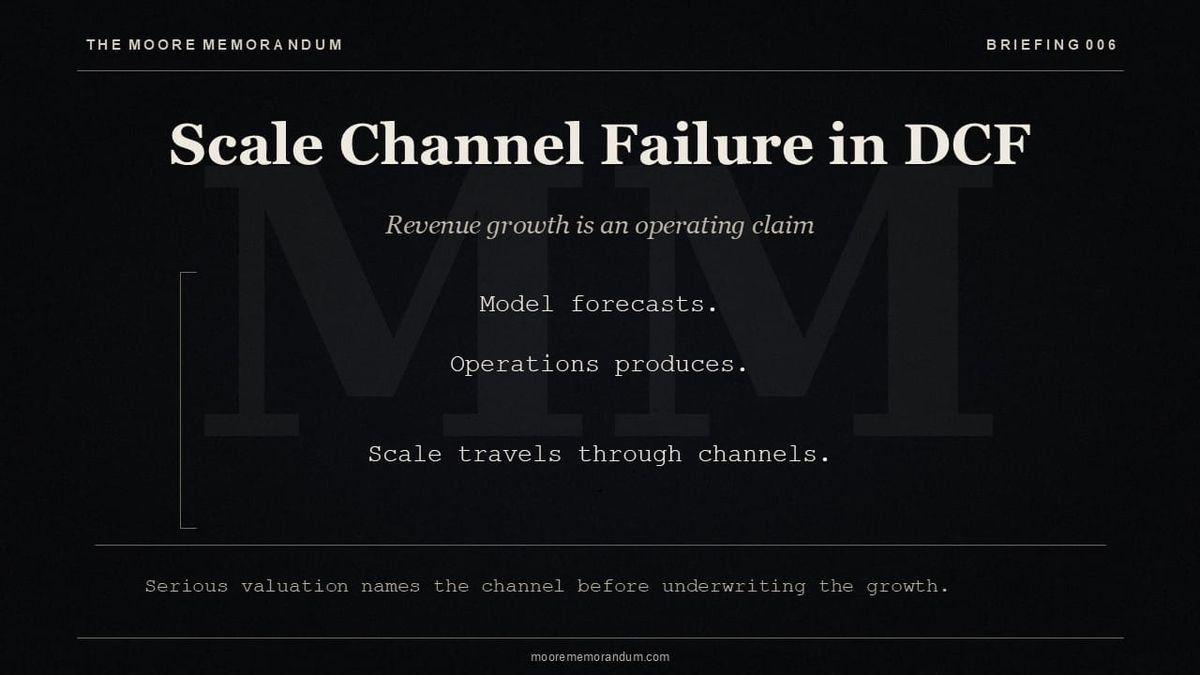
Scale travels through channels. Channels have capacity, cost, timing, friction, and degradation. Serious valuation makes those constraints visible.
The rule is simple:
Never underwrite scale without naming the channel that carries it.
Sources
- Frank M. Bass, “A New Product Growth Model for Consumer Durables,” Management Science 15, no. 5 (1969): 215–227. Bass develops and empirically tests a growth model for timing of initial purchase in new products, linking adoption timing to prior buyers and offering an innovator/imitator rationale.
- Katherine N. Lemon and Peter C. Verhoef, “Understanding Customer Experience Throughout the Customer Journey,” Journal of Marketing 80, no. 6 (2016): 69–96.
- Roland T. Rust, Katherine N. Lemon, and Valarie A. Zeithaml, “Return on Marketing: Using Customer Equity to Focus Marketing Strategy,” Journal of Marketing 68, no. 1 (2004): 109–127.
- Werner Reinartz, Jacquelyn S. Thomas, and V. Kumar, “Balancing Acquisition and Retention Resources to Maximize Customer Profitability,” Journal of Marketing 69, no. 1 (2005): 63–79.
- Aswath Damodaran, Investment Valuation: Tools and Techniques for Determining the Value of Any Asset, 3rd ed. Wiley, 2012.
- Tim Koller, Marc Goedhart, and David Wessels, Valuation: Measuring and Managing the Value of Companies, Wiley.