The Moore Memorandum — Briefing #008
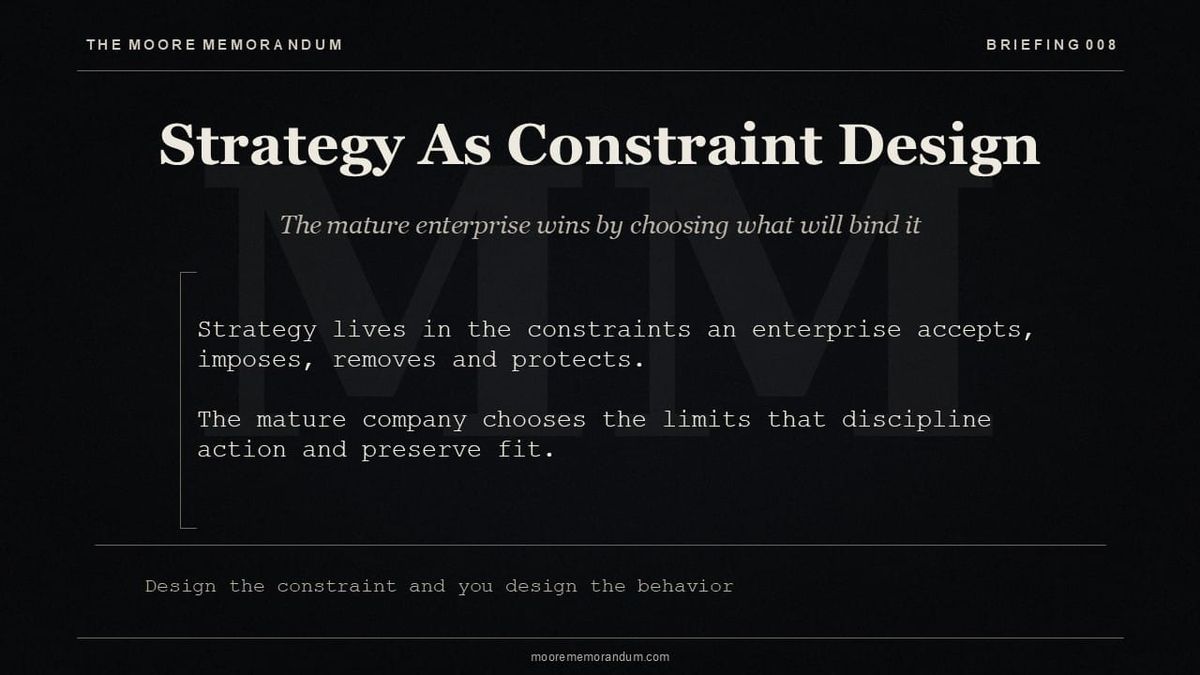
Strategy lives in the constraints an enterprise accepts, imposes, removes, and protects. Briefing 008 explains how mature companies design limits that discipline action and preserve fit.
Strategy as Constraint Design
The mature enterprise wins by choosing what will bind it
Executive Summary
Strategy becomes real when it changes the constraints under which the enterprise acts. Markets, capital, talent, regulation, customer trust, technical architecture, channel capacity, and decision rights all impose limits. Mature strategy selects, sequences, and governs those limits.
Aspirational strategy names desired outcomes: growth, innovation, differentiation, speed, quality, enterprise expansion, AI adoption, platform scale. Operational strategy specifies the rules that make those outcomes executable: customers served, risks refused, channels privileged, interfaces owned, metrics obeyed, and commitments made durable.
Constraint design draws on several serious traditions: Porter’s work on tradeoffs and activity fit, Goldratt’s theory of constraints, Meadows’s systems leverage points, Spear and Bowen’s account of Toyota’s operating rules, and Eisenhardt and Sull’s simple-rules strategy for complex environments.
The executive discipline is to identify the binding constraint, decide whether to relieve it, exploit it, move it, preserve it, or replace the strategy, and then align the operating system around that choice.
The board’s question is direct:
Which constraint are we designing around, and what behavior will it force?
1. The Pattern
Most strategy documents describe destination.
A company will expand into enterprise.
Adopt AI.
Improve retention.
Scale the platform.
Move upmarket.
Protect quality.
Increase innovation.
Strengthen resilience.
Each objective may be sound. Each remains under-specified until management identifies the constraint system that will govern the work.
Enterprise expansion brings procurement, security review, implementation capacity, executive sponsorship, and longer sales cycles. Retention may require narrower product scope, better onboarding, cleaner handoffs, and more reliable service. AI adoption may require approved use cases, data-access rules, auditability, and deployment gates. Innovation may require fewer projects, stronger stage-gates, and clearer evidence thresholds.
Strategy begins to operate when ambition becomes a chosen set of limits.
2. What Constraint Design Means
A constraint is a limit that shapes conduct.
Some constraints are external: regulation, capital markets, procurement cycles, customer willingness to pay, standards bodies, supply-chain capacity, labor markets, competitor moves.
Some constraints are internal: talent, architecture, data quality, cash runway, decision rights, manufacturing capacity, implementation bandwidth, managerial attention, tolerance for risk.
Some constraints are chosen: pricing rules, quality standards, approval gates, channel focus, product scope, claim boundaries, customer qualification, capital thresholds, evidence requirements.
The chosen constraints are the strategic ones.
Where management leaves constraints unchosen, the organization defaults to the strongest pressure in the system: the loudest customer, the fastest revenue, the most powerful executive, the most fragile platform, the easiest channel, the most urgent crisis, or the legacy habit with the deepest political protection.
Constraint design is the deliberate construction of the limits that guide the enterprise toward its intended future.
3. The Strategic Use of Limits
The most disciplined strategies reduce degrees of freedom.
That can seem counterintuitive. Enterprise freedom has value. It allows adaptation, local judgment, and initiative. Yet unmanaged freedom creates drift: each function optimizes locally; each executive preserves optionality; each project asks for more time; each customer exception becomes a precedent.
The result is a firm with many activities and little coherence.
Porter’s strategy work is useful because it emphasizes tradeoffs and fit among activities. The enduring executive lesson is straightforward: a strategic position gains power when the company’s activities reinforce one another and when management accepts real tradeoffs rather than pursuing every attractive path.
Constraint design makes those tradeoffs enforceable.
It asks:
| Strategic Question | Constraint Translation |
|---|---|
| Which customers will we serve? | customer qualification rules |
| Which opportunities will we decline? | boundary constraints |
| Which channels receive priority? | channel allocation rules |
| Which risks will we refuse? | risk gates and escalation thresholds |
| Which product promises are allowed? | claims and evidence rules |
| Which metric governs local action? | operating dashboard and trigger system |
| Which commitments become irreversible? | capital, hiring, architecture, and partner gates |
A constraint becomes strategic when it protects the fit of the system.
4. Four Classes of Strategic Constraint
1. Boundary Constraints
Boundary constraints define where the company competes.
They include:
- customer segments served;
- geographies entered;
- product categories pursued;
- regulated use cases accepted;
- channels privileged;
- product claims made or refused;
- partners allowed to touch the customer;
- markets excluded for reasons of margin, trust, regulation, or focus.
Boundary constraints protect the enterprise from attractive incoherence.
Executive test: Can management state which customers, products, channels, claims, and opportunities the firm will decline this year?
2. Throughput Constraints
Throughput constraints determine how much the system can process.
They include:
- sales capacity;
- onboarding capacity;
- manufacturing bottlenecks;
- implementation bandwidth;
- customer-support load;
- data-processing infrastructure;
- regulatory-review capacity;
- management attention.
Goldratt’s theory of constraints popularized the discipline of identifying the system constraint and organizing improvement around it. The theory’s five focusing steps—identify, exploit, subordinate, elevate, and repeat—remain useful because they keep management focused on the limiting factor rather than the most visible symptom.
Executive test: Which constraint limits throughput today, and which metric proves it?
3. Governance Constraints
Governance constraints define who may decide, when, and under what evidence.
They include:
- investment thresholds;
- approval gates;
- risk escalations;
- stop rules;
- conflict procedures;
- deployment gates;
- board triggers;
- pricing authority;
- discounting limits;
- procurement authority;
- product-launch rules.
Governance constraints convert judgment into a durable operating rule. They protect the enterprise from local urgency, political pressure, and informal exception-making.
Executive test: Which decisions are currently made too low, too high, too slowly, or by the wrong party?
4. Learning Constraints
Learning constraints require evidence before scale.
They include:
- pilot standards;
- customer-observation requirements;
- reference-class checks;
- validation thresholds;
- cohort-retention requirements;
- postmortem cadence;
- stage-gated capital;
- launch-readiness criteria;
- minimum proof before public claims.
Toyota’s operating discipline, as analyzed by Spear and Bowen, is instructive here: specified work, direct connections, simple pathways, and improvement through disciplined experimentation create a system that learns by design.
Executive test: What must we learn before the next tranche of capital, headcount, or public commitment is released?
5. The Constraint Ledger
The practical tool is a constraint ledger.
| Constraint | Type | Current Evidence | Strategic Choice | Owner | Cadence |
|---|---|---|---|---|---|
| Onboarding capacity | Throughput | activation delays rising | relieve before new acquisition spend | COO | weekly |
| Discount authority | Governance | margin leakage by sales team | tighten approval above threshold | CFO | monthly |
| Enterprise security review | Boundary / throughput | deals stall at InfoSec | build compliance packet before expansion | CTO / Sales | biweekly |
| Product-roadmap scope | Boundary | feature count rising while quality weakens | freeze non-core surface for one quarter | CPO | monthly |
| Pilot evidence threshold | Learning | pilots called successful without adoption proof | require activation and retention before scale | CEO / Board | quarterly |
The ledger makes strategy inspectable. It converts focus into named limits with evidence, owners, and review cycles.
A constraint without an owner becomes a recurring complaint. A constraint without cadence becomes stale. A constraint without evidence becomes politics.
6. The Five Moves
Once the constraint is identified, management has five legitimate moves.
Move 1 — Relieve the Constraint
Add capacity, talent, capital, infrastructure, tooling, process discipline, or automation.
Use this move when the constraint blocks a strategy that remains correct.
Example: implementation capacity limits enterprise expansion; management invests in onboarding systems and specialist teams before adding more enterprise sales coverage.
Move 2 — Exploit the Constraint
Keep the constraint fixed and redesign the system to maximize value through it.
Use this move when the constraint cannot be relieved quickly.
Example: sales capacity is limited; management concentrates on fewer accounts with higher conversion, stronger margin, and clearer implementation fit.
Move 3 — Move the Constraint
Shift the bottleneck to a more favorable place in the system.
Use this move when the current constraint produces poor economics.
Example: custom services constrain software scale; productization moves the constraint from labor availability to product architecture and onboarding design.
Move 4 — Preserve the Constraint
Maintain a limit because it protects trust, quality, focus, capital discipline, or strategic fit.
Use this move when more volume would damage the enterprise.
Example: strict customer qualification slows growth while preserving retention, implementation quality, and brand reliability.
Move 5 — Replace the Strategy
Acknowledge that required constraint relief exceeds the company’s time, capital, authority, or legitimacy.
Use this move when the strategy depends on a constraint the company cannot move at an acceptable cost.
Example: regulated-market entry requires evidence, approvals, and runway beyond the firm’s capacity; management licenses, partners, narrows, or exits.
The important distinction: some constraints are bottlenecks, some are protections, some are symptoms, and some are the strategy.
7. Simple Rules as Constraint Architecture
Complex environments require rules that are few enough to remember and strong enough to shape conduct.
Eisenhardt and Sull’s “Strategy as Simple Rules” is valuable because it treats strategy in fast-moving markets as a limited set of rules that guide recurring decisions under uncertainty.
Examples:
| Rule | Constraint Function |
|---|---|
| No discount below the gross-margin floor without CFO approval. | protects unit economics |
| No feature launch without rollback capability. | protects reliability |
| No enterprise account without reserved implementation capacity. | protects delivery |
| No pilot scale-up until activation and retention thresholds clear. | protects learning discipline |
| No partnership that moves the customer interface outside company control. | protects strategic position |
| No revenue that requires unsupported product claims. | protects trust and compliance |
These rules reduce improvisation at known decision points. They give local teams freedom inside boundaries that preserve the strategy.
8. Constraint Design in Innovation
Innovation suffers when constraints are absent, hidden, or poorly chosen.
Absent constraints allow teams to explore broadly while postponing the market decision. Hidden constraints—procurement, regulation, integration, trust, talent, or data rights—arrive late and reshape the project after capital has been spent. Poorly chosen constraints optimize the wrong proxy: demo quality, patent count, pilot volume, press interest, or executive visibility.
Strategic innovation uses constraints deliberately:
- technical thresholds;
- commercial evidence gates;
- product-surface boundaries;
- data-use rules;
- partner-control limits;
- launch claims;
- capital tranches;
- stop conditions.
A serious innovation program asks:
| Question | Constraint Implication |
|---|---|
| What must be true technically? | performance threshold |
| What must be true commercially? | willingness-to-pay or adoption threshold |
| What must be true legally? | permission, claim, or data-use boundary |
| What must be true operationally? | support, quality, and delivery threshold |
| Which constraint will bind first? | priority of action |
| What evidence changes the decision? | stage-gate and stop rule |
That is the difference between a portfolio and a list of promising ideas.
9. Where Constraint Design Fails
Failure Mode 1 — Constraint Blindness
The organization attacks symptoms because it cannot name the binding constraint.
Sales is blamed for a product issue. Product is blamed for a procurement issue. Marketing is blamed for an implementation bottleneck. Finance is blamed for an adoption problem.
Correction: identify the constraint using evidence rather than senior preference.
Failure Mode 2 — Local Optimization
Each function improves its own performance while weakening the system.
Sales increases volume while onboarding capacity collapses. Engineering ships faster while support cost rises. Finance reduces cost while quality deteriorates. Procurement lowers price while supplier reliability weakens.
Correction: govern the system constraint, not isolated departmental metrics.
Failure Mode 3 — Constraint Recognition Without Decision
Management names the bottleneck and then approves actions that intensify it.
The board hears that implementation capacity is the constraint and then approves additional sales headcount. The diagnosis enters the minutes and leaves no imprint on capital allocation.
Correction: require every constraint diagnosis to change at least one decision.
Failure Mode 4 — Over constraint
The company adds gates, policies, and committees until execution becomes procedural rather than decisive.
Good constraints clarify conduct. Excessive constraints produce avoidance, delay, and administrative compliance.
Correction: remove rules that do not protect strategy, risk, learning, or trust.
Failure Mode 5 — Preserving the Wrong Constraint
A legacy product, metric, approval habit, customer type, or channel remains protected after the market has moved.
Correction: make every preserved constraint state its present strategic function.
10. The Board’s Constraint Questions
Boards and senior teams should ask:
- Which constraint currently limits the strategy?
- Which constraints have we chosen deliberately?
- Which constraints have we inherited accidentally?
- Which constraint protects quality, trust, or fit?
- Which constraint protects habit?
- Which function benefits from the current constraint?
- Which function absorbs the cost?
- Which constraint will bind if volume doubles?
- Which constraint must be relieved before more capital is released?
- Which rule would prevent the most likely strategic drift?
The ninth question is especially important. More capital rarely solves a misdesigned constraint system.
11. Constraint Design Protocol
A practical protocol fits on one page.
Step 1 — State the strategic objective
Example: move from founder-led midmarket sales to repeatable enterprise adoption.
Step 2 — Name the likely constraints
Customer trust, procurement, security review, implementation capacity, sales cycle, pricing authority, product reliability, data access, customer support, and executive sponsorship.
Step 3 — Identify the binding constraint
Use evidence: queue length, cycle time, conversion loss, defect rate, utilization, margin leakage, customer delay, support burden, or cash timing.
Step 4 — Choose the constraint move
Relieve, exploit, move, preserve, or replace.
Step 5 — Write the rule
Example: no enterprise contract signs unless implementation capacity is reserved and the security-review packet is complete.
Step 6 — Assign owner and cadence
A constraint requires a named owner and a review rhythm.
Step 7 — Re-test after movement
When one bottleneck moves, another appears. Strategy evolves as constraints migrate.
Closing
Strategy lives in the constraints an enterprise accepts, imposes, removes, and protects.
A company can speak fluently about ambition while inherited constraints govern its conduct. A serious company chooses the constraints that discipline action, preserve fit, and make the intended strategy operational.
The rule is simple:
Design the constraint, and you design the behavior.
Sources
- Michael E. Porter, “What Is Strategy?” Harvard Business Review, November–December 1996. Porter’s article is the canonical modern account of strategy as activity fit and tradeoffs; the HBR page identifies the article, author, and issue.
- Eliyahu M. Goldratt, The Goal: A Process of Ongoing Improvement, North River Press, originally published 1984. The work popularized bottleneck and theory-of-constraints reasoning in management; summaries describe its focus on identifying and alleviating bottlenecks in operations.
- Donella H. Meadows, “Leverage Points: Places to Intervene in a System,” 1999; later expanded in Thinking in Systems. Meadows’s work is the classic systems account of intervention points and leverage in complex systems.
- Steven J. Spear and H. Kent Bowen, “Decoding the DNA of the Toyota Production System,” Harvard Business Review, September–October 1999. The article identifies Toyota’s operating discipline around specified work, direct connections, simple pathways, and scientific improvement.
- Kathleen M. Eisenhardt and Donald Sull, “Strategy as Simple Rules,” Harvard Business Review, January 2001. The article frames strategy in fast-moving markets through a limited set of simple rules.